

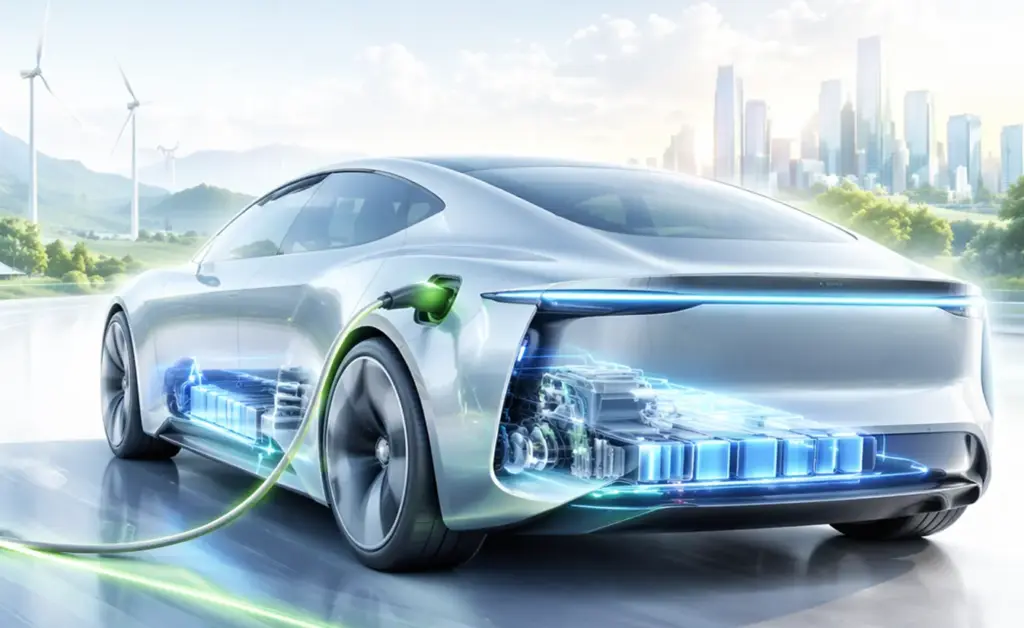
For more than a decade, graphite has been the standard anode material used in lithium-ion batteries. However, growing demand from electric vehicles, consumer electronics and energy storage systems for higher energy density, faster charging and improved performance is pushing graphite closer to its practical limits. Silicon is emerging as one of the most promising alternatives and the most practical way to harness silicon’s enormous potential is through engineered silicon carbon (Si-C) composite anodes, a technology in which high-performance porous carbon plays a key role in supporting silicon integration.
Haycarb’s new HCE 400 Series of engineered porous carbons has been developed specifically for this frontier, as a precision built scaffold for next-generation Si-C anode materials. Drawing on Haycarb’s decades of expertise in coconut shell carbon science, the HCE 400 Series is designed to be a true catalyst for the transition to silicon dominant energy storage.
01. Why Silicon and Why Now
Graphite anodes store lithium with a theoretical capacity of about 372 mAh/g. Silicon, by contrast, can theoretically store roughly 4,200 mAh/g . This is more than ten times because each silicon atom can accommodate up to about 4.4 lithium atoms. For battery designers chasing higher energy density, that is a transformative difference.

The main challenge is silicon’s significant volume change during cycling. As it absorbs lithium, silicon can expand by up to 300% and then contract during discharge. Without effective control, this repeated expansion and contraction can fracture the particles, disrupt electrical contact and expose new surfaces to the electrolyte. These effects consume lithium and accelerate capacity loss, which has slowed the commercial adoption of silicon anodes.
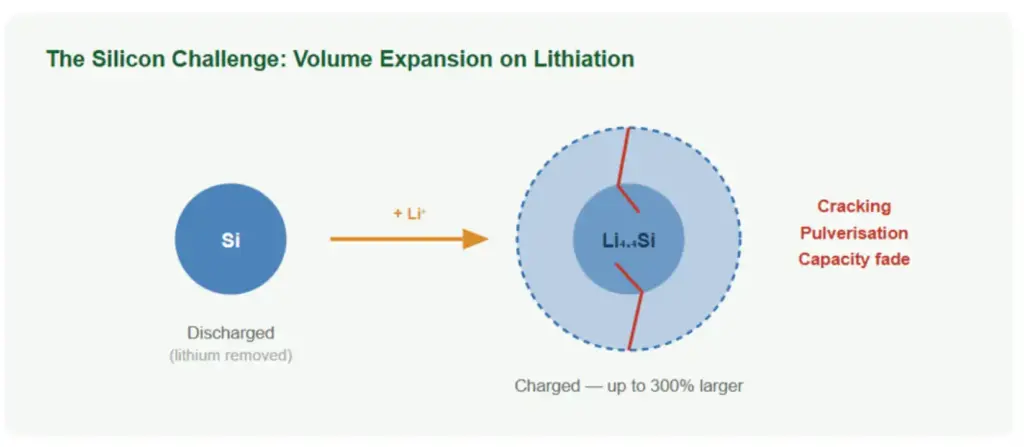
Figure 1. As silicon absorbs lithium it can expand by up to ~300% in volume. Unconstrained, this repeated expansion and contraction fractures the particle and destabilizes the electrode, the central barrier to using silicon in commercial cells
02. The Breakthrough: Silicon-Carbon Composites
Silicon–carbon (Si–C) composites have emerged as one of the most successful approaches for translating silicon’s theoretical advantages into commercially viable battery materials. Rather than using bulk silicon, manufacturers incorporate nano sized, amorphous silicon within a carbon host structure, which may be based on biomass derived engineered porous carbons, synthetic carbons or resin derived carbon matrices. Among the available approaches, porous carbon provides an internal structure in which silicon can be deposited while leaving space to manage volume changes during cycling. A widely used commercial method is chemical vapour deposition (CVD), where silane (SiH₄) decomposes within the pore network and forms nanoscale silicon deposits.
This architecture helps accommodate silicon expansion, maintain electrical connectivity and support stable SEI formation for improved cycling performance.
Why Si-C is winning. Among silicon anode approaches, silicon-carbon composites have emerged as the dominant commercial chemistry, chosen for their balance of high energy density, cycle life and structural stability, and because they can be integrated as a “drop-in” material into existing lithium-ion manufacturing lines. Leading Si-C composites already deliver energy density gains of up to ~50% over graphite and fast charge capability in under ten minutes, with cycle life data now reported in the 1,500 – 3,000 cycle range.
03. A Market on a Steep Growth Curve
The commercial momentum behind silicon anodes is striking. Independent market analysts place the silicon anode battery market at roughly USD 0.5 billion in 2025, with projections to USD 26 – 31 billion by 2035, implying compound annual growth rates approaching 50%. Across these forecasts, silicon carbon composites are consistently identified as a key anode material supporting the shift toward higher-performance batteries.
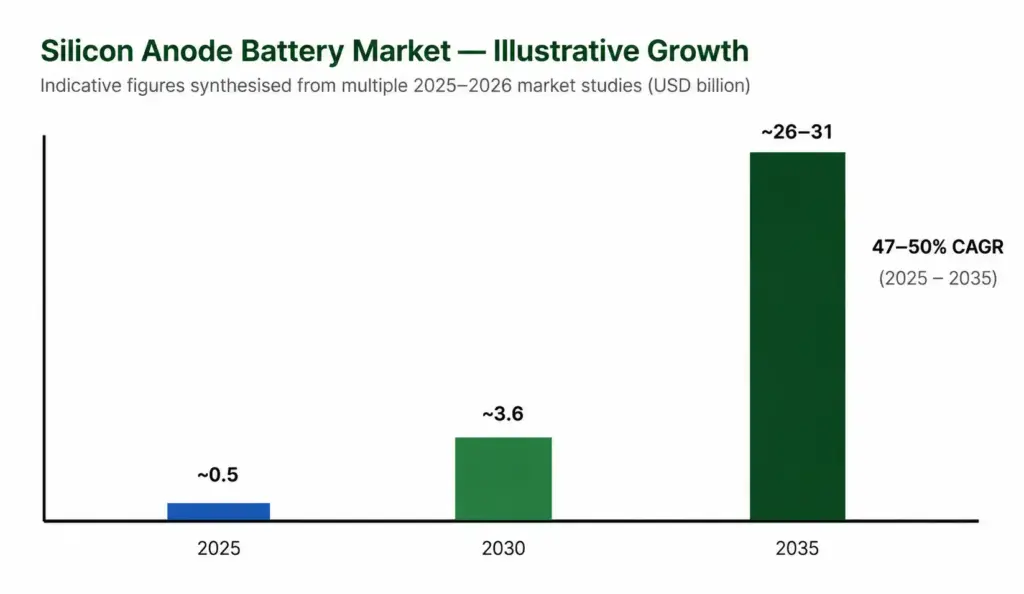
Figure 3. Projected growth of the silicon-anode battery market from approximately USD 0.5 billion in 2025 to USD 26 – 31 billion by 2035, based on published market forecasts. Source: Adapted from published industry forecasts and market analyses and other silicon-anode battery market studies (2025 – 2026)
This growth is being driven by demand from electric vehicles for longer range and faster charging, from consumer and AI enabled devices for greater energy storage in smaller formats and from grid storage systems for higher energy density and longer service life. In every case, the performance ceiling now runs through the anode and the anode increasingly runs on engineered porous carbon.
04. The Scaffold Makes the Difference
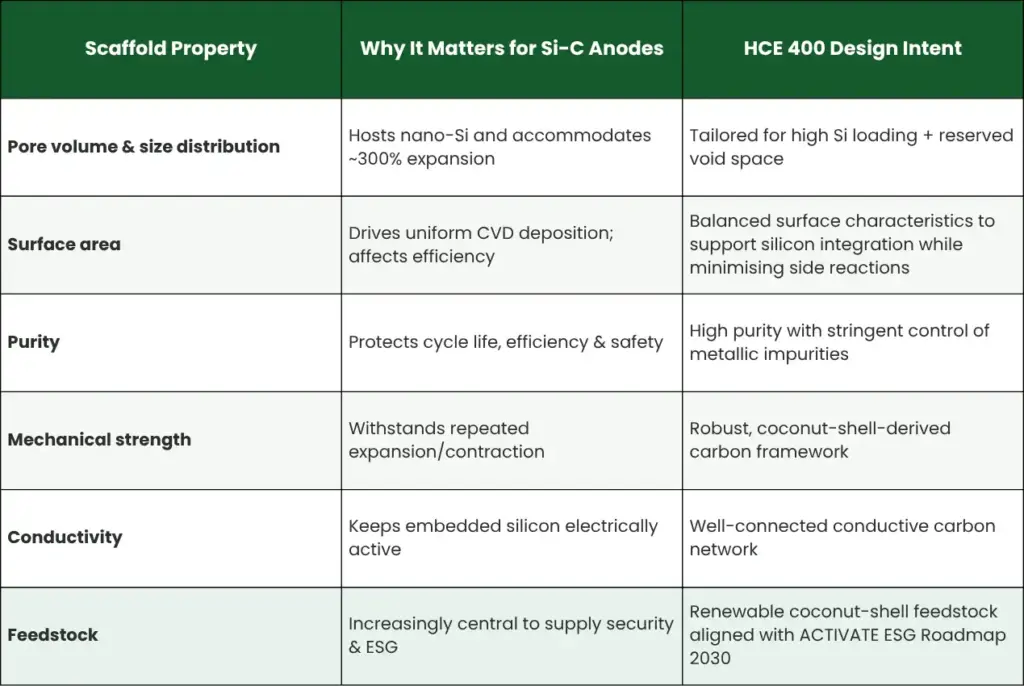
If silicon is the active ingredient, the porous carbon scaffold is the architecture that makes silicon usable. The performance of a Si-C composite is governed to a remarkable degree by the properties of that carbon host and not just any carbon will do. The scaffold must satisfy a demanding and interdependent set of requirements:
- Tailored pore volume and structure – The pore network must provide enough internal volume and microporosity to host the silicon and accommodate its expansion, with the right balance of pore sizes to allow uniform silane infiltration during CVD.
- Controlled surface area – Surface area must be high enough for efficient, uniform silicon deposition, yet managed to limit electrolyte side reactions and maximize first cycle efficiency.
- High purity – Trace metallic and ionic impurities can cause unwanted reactions that reduce battery safety, performance and service life.
- Mechanical robustness – The scaffold must hold its shape under the repeated mechanical stress of silicon’s expansion and contraction.
- Electrical conductivity – A well connected carbon framework keeps the embedded silicon electrically active throughout the particle.
05. Introducing the Haycarb HCE 400 Series
The HCE 400 Series is Haycarb’s purpose engineered family of porous carbons developed as a scaffold for silicon–carbon composite anodes. Its coconut shell derived carbon is engineered to provide a controlled, application specific pore architecture, pore volume, surface characteristics and high purity suited to silicon loading and expansion accommodation. These capabilities are supported by Haycarb’s decades of expertise in coconut shell carbon science and globally consistent, quality controlled manufacturing
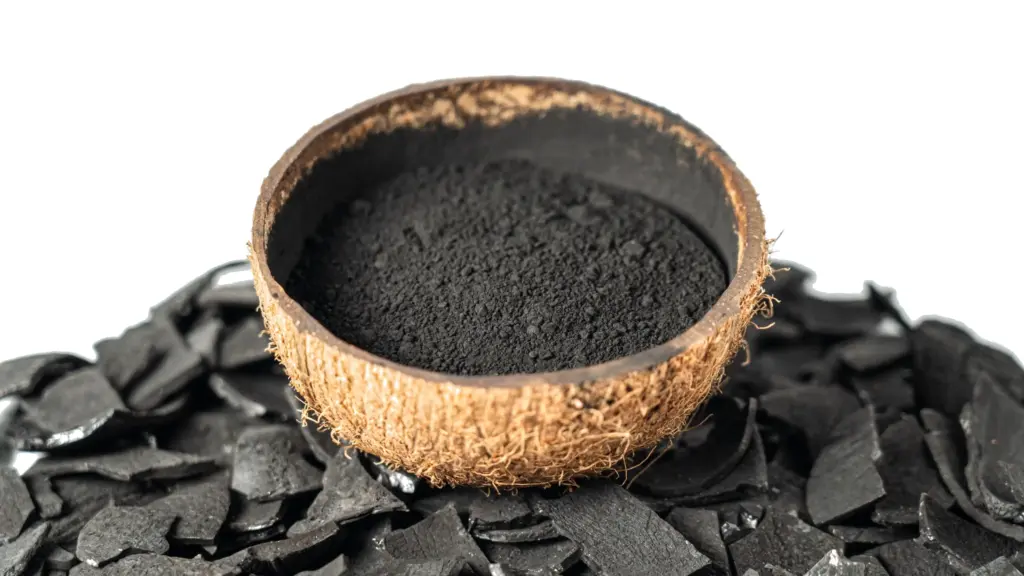
The HCE 400 Series is designed to provide:
Optimized pore architecture and controlled pore volume – a defined pore structure that maximizes silicon loading while maintaining the internal void space needed to accommodate volume changes during cycling, supporting stable and durable battery performance.
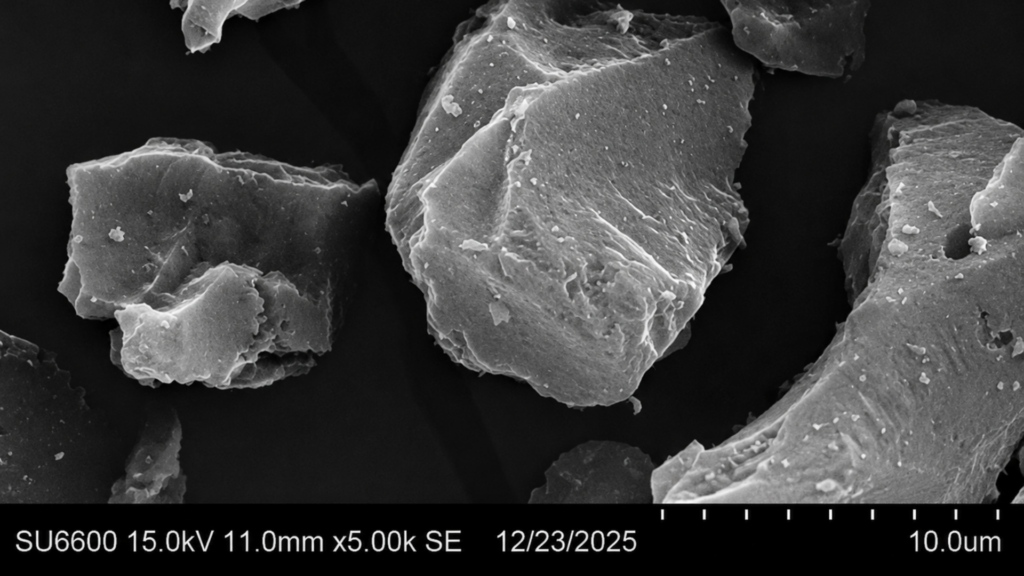
Figure 4: SEM image of Haycarb HCE 400 Series porous carbon showing the surface morphology
Ultra-high purity – stringent control of impurities to protect first-cycle efficiency, cycle life and cell safety.
Structural and conductive integrity – a robust, well-connected carbon framework that maintains mechanical stability and electrical contact over extended cycling.
Controlled Particle Size Distribution – Haycarb’s HCE 400 Series is engineered to deliver precise particle size distribution control, resulting in excellent surface morphology and particle uniformity.
Sustainable raw material – built on Haycarb’s renewable coconut-shell feedstock and aligned with the company’s “ACTIVATE” ESG Roadmap 2030. The HCE 400 Series has a carbon footprint of approximately 1.47 kg CO₂e/kg, offering a lower-carbon alternative to many fossil-derived carbon materials used in battery applications.
The table below summarizes typical surface area and pore volume ranges across the HCE 400 Series.
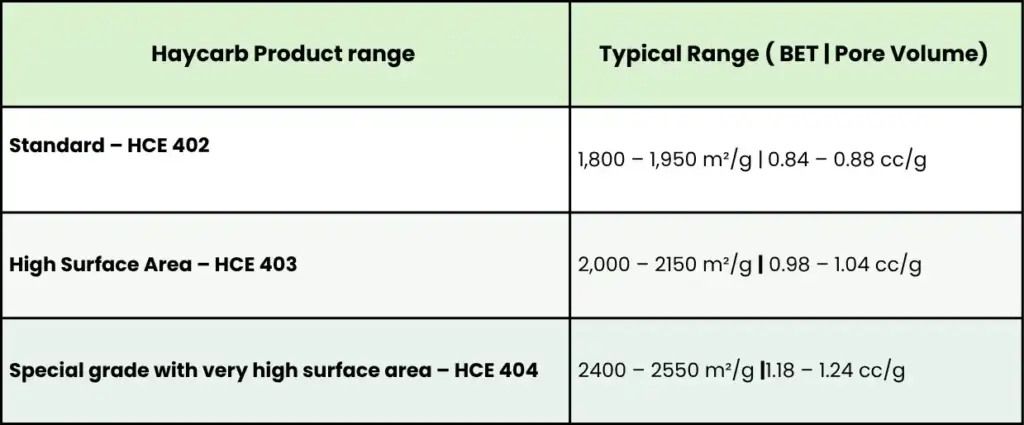
Note: figures shown are typical/indicative ranges across the HCE 400 Series. Consult the official technical datasheet for grade specific specifications.
06. A Catalyst for the Silicon Era
The shift from graphite to silicon is one of the most consequential transitions in modern energy storage and it is being built, quite literally, around engineered porous carbon. As battery makers race to commercialize higher capacity, faster charging cells, the demand for anode-grade scaffold carbons is set to grow in lockstep with the silicon anode market itself.
With the HCE 400 Series, Haycarb brings to this frontier exactly what the application demands: precision pore engineering, ultra high purity, mechanical robustness, precise particle size distribution, and a sustainable, renewable feedstock, underpinned by advanced R&D capabilities, materials science expertise and manufacturing consistency that have made Haycarb a global leader in activated and engineered carbons. The HCE 400 Series is more than a material it is a catalyst for the next generation of lithium-ion and silicon batteries.
Today, Haycarb is a leading high volume producer of porous carbons for silicon carbon (Si-C) anode applications, with a major capacity expansion program underway and a new production facility scheduled for commissioning in Q1 2027
Partner with Haycarb on the Future of Energy Storage
For companies developing Si–C composite anodes for electric vehicles, consumer electronics or grid storage applications, Haycarb’s HCE 400 Series provides an engineered porous carbon framework to support effective silicon integration. Our R&D team works with customers on material selection, specification development and application specific optimization.
Contact our team to discuss your requirements.
Frequently Asked Questions
- What is a silicon–carbon (Si–C) composite anode? A silicon–carbon composite anode contains nanoscale silicon within a porous carbon structure. Silicon provides high lithium-storage capacity, while the carbon framework supports electrical conductivity and structural stability. The internal pore space also helps accommodate the volume changes that occur during charging and discharging.
- Why can’t pure silicon simply replace graphite? Silicon can expand by up to approximately 300% as it absorbs lithium. In bulk form, this repeated expansion and contraction can fracture the particles, disrupt electrical contact and destabilise the electrode surface. These effects lead to rapid capacity loss and limit the practical use of pure silicon in commercial batteries. Nano-confining silicon inside a porous carbon scaffold is the practical way to capture its capacity while controlling expansion.
- What role does the porous carbon scaffold play? The scaffold is decisive. Its pore volume hosts the silicon and absorbs expansion, its conductive framework keeps the silicon electrically active, its surface controls electrolyte side reactions, and its purity protects cycle life and safety. The quality of the carbon largely determines the performance of the finished Si-C anode.
- How is silicon introduced into the carbon? One of the most widely adopted commercial methods is chemical vapour deposition (CVD), in which silane (SiH4) gas flows into the porous carbon and decomposes, growing nano-silicon directly inside the pore network. This requires a carbon scaffold with an open, accessible and well-tuned pore structure.
- What makes the Haycarb HCE 400 Series suited to this application? The HCE 400 Series is engineered specifically as a Si-C scaffold, offering an optimized pore architecture for high silicon loading and expansion accommodation, ultra high purity, mechanical robustness, precise particle size distribution control, and conductivity, all built on Haycarb’s renewable coconut shell feedstock and globally consistent manufacturing.
- Is the HCE 400 Series sustainable? Yes. It is derived from renewable coconut shell raw material rather than fossil sources, and is aligned with Haycarb’s “ACTIVATE” ESG Roadmap 2030, supporting supply security and lower carbon battery material supply chains.
- Why is purity important in Si-C anodes? Metallic impurities can contribute to unwanted side reactions and impact electrochemical performance. The HCE 400 Series is manufactured with stringent impurity control to support high first-cycle efficiency, long cycle life and reliable battery performance.