
How Haycarb’s HCE 200 series connects electrode science, dependable supply and sustainable innovation.
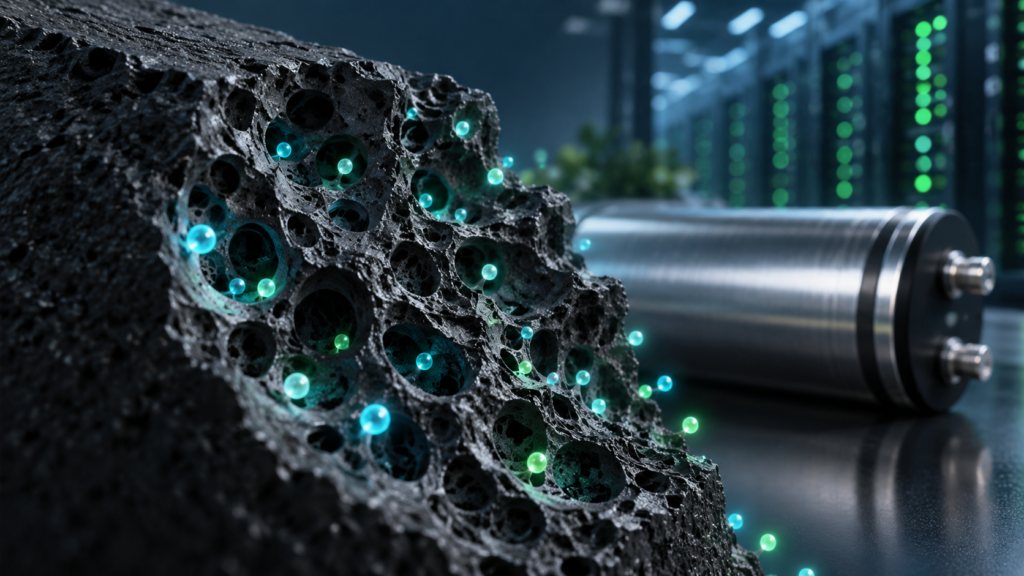
The AI revolution is creating a new challenge for power infrastructure: supplying electricity reliably when demand can change almost instantly.
The International Energy Agency projects that global data-centre electricity consumption will approximately double from 485 TWh in 2025 to 950 TWh by 2030, with electricity consumption from AI-focused data centres growing even faster. Behind this expansion lies an equally significant engineering challenge, managing the rapid fluctuations generated by increasingly powerful computing systems.
(Source: International Energy Agency, Key Questions on Energy and AI, Executive Summary)
As thousands of processors move between intensive computation, communication and idle periods, their combined demand can rise and fall sharply. Power infrastructure must accommodate both the scale of consumption and the speed of change.
Supercapacitors can absorb and release energy rapidly, making them particularly useful for repeated power pulses, short-duration peak support, and brief ride-through. Their high-power capability and ability to withstand repeated charge-discharge cycles make them well suited to the rapidly changing load profiles associated with AI computing.
AI moves fast. The materials supporting its power systems must keep pace.
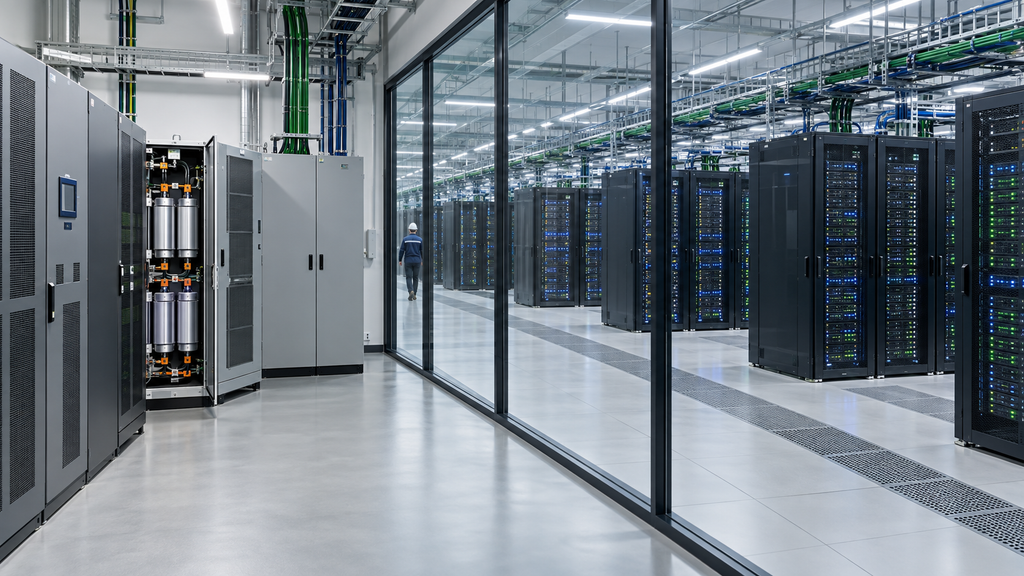
Supercapacitors can absorb and release energy rapidly, making them particularly useful for repeated power pulses, short-duration peak support and brief ride-through. Integrated with suitable converters and controls, they can smooth the demand presented to upstream power equipment.
Leading technology companies such as NVIDIA are already designing power architectures around this need. NVIDIA’s developing 800 VDC architecture reflects the distinction between short duration, high power support and longer duration energy storage, incorporating capacitors near compute racks alongside battery systems.
(Source: NVIDIA, Building the 800 VDC Ecosystem for Efficient, Scalable AI Factories)
Achieving that performance begins well before a storage module reaches the data centre. It begins with the electrode.
Beyond surface area: why pore structure matters?
In an electric double-layer capacitor, or EDLC, charge is stored primarily through the reversible accumulation of electrolyte ions at the electrode surface. Activated carbon’s extensive internal pore network provides a large interface for this process within a compact volume.
The carbon is therefore an active part of the energy storage mechanism. Its structure and chemistry help determine how much charge can be stored, how readily ions can access the surface, and how consistently the device performs.
A high surface area measurement alone cannot answer those questions. The useful surface must be accessible to the selected electrolyte within the required charge-discharge time. Pore dimensions, connectivity and electrode structure must work together to balance charge storage with rapid ion movement.
For AI power management, this distinction matters. A material must support performance under repeated pulses, beyond what a single capacitance measurement reveals.
Purity and surface chemistry shape reliability.
Electrode carbon must also be extremely clean. Residual metals, inorganic impurities and unwanted moisture can contribute to parasitic reactions, leakage, gas generation and deterioration, depending on the electrolyte and operating conditions.
Surface chemistry requires equally careful control. Oxygen-containing functional groups influence wettability and interactions between carbon and electrolyte. Their effects depend on the type of group, its concentration and the cell chemistry. In organic-electrolyte EDLCs, some groups can promote unwanted reactions or increase resistance.
Research has demonstrated that controlling these groups while preserving pore structure can improve electrochemical performance. The objective is an appropriate surface chemistry for the application, rather than simply maximising or minimising total oxygen.
(Source: “Effects of Oxygen-Containing Functional Groups on the Electrochemical Performance of Activated Carbon for EDLCs,” Nanomaterials)
Particle size, packing and electrode processing complete the picture. They influence coating uniformity, electrical contact, ion transport and the amount of active material that can be accommodated in a practical electrode.
Together, these factors explain why supercapacitor carbon is a specialised engineered material.
A decade of consistency behind every new application.
ヘイカーブの HCE 200 series, including HCE 200 and HCE 202, brings more than a decade of experience in supplying consistent-quality carbons for supercapacitor electrode.
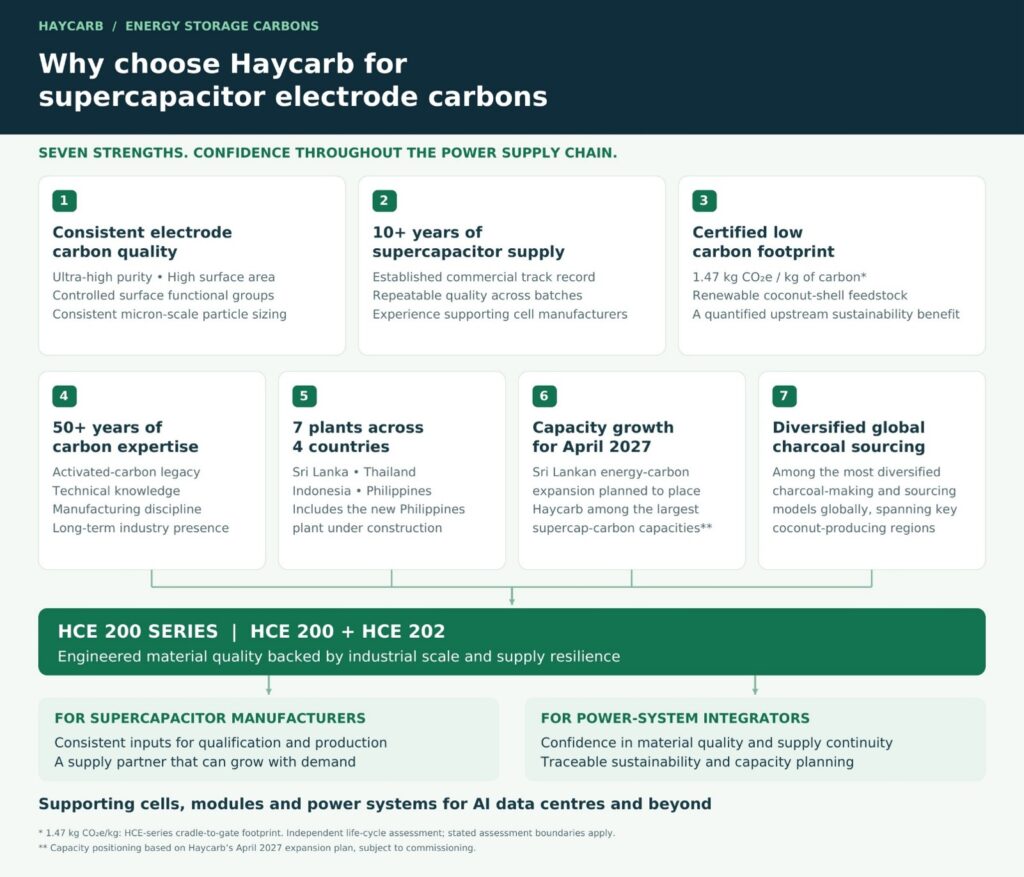
Our approach combines ultra-high purity, controlled pore characteristics, carefully managed surface functional groups, and precise particle sizing with the manufacturing discipline needed to reproduce material properties from batch to batch.
That consistency matters throughout qualification and production. Cell manufacturers must translate an approved formulation into dependable commercial output. Module manufacturers need predictable cell behavior. Power-system integrators need confidence in the components supporting their designs.
The final performance depends on the complete cell and system including electrolyte, binder, electrode construction, balancing, and thermal management. Haycarb’s contribution is to provide a dependable material foundation, together with the technical support needed to tailor it to the application.
Reliable power begins with reliable supply.
The AI infrastructure supply chain connects carbon producers, electrode and cell manufacturers, module suppliers, power-system integrators, developers, and operators. Expanding demand places pressure on every link.
For specialised carbon, scaling production requires secure feedstock as well as processing capacity. Coconut charcoal supply is geographically dispersed and influenced by agricultural conditions, collection networks, conversion practices, competing demand, and logistics.
Haycarb’s global operations and established relationships across key coconut-producing regions provide an important foundation for managing this complexity. Local sourcing knowledge, supplier development, and coordinated manufacturing help support continuity while maintaining the raw-material discipline required for advanced carbons.
Haycarb is also significantly expanding its specialised manufacturing capacity, with ongoing projects expected to reach full additional capacity by April 2027. This expansion will strengthen the company’s ability to support rapidly growing demand from energy-storage and AI-related power applications.
Alongside this, Haycarb’s seventh greenfield activated carbon manufacturing plant is expected to be commissioned in the Philippines by Q1 2027, further strengthening both upstream raw-material integration and downstream production capability.
As value-added capacity expands, this supply strength becomes increasingly relevant to customers planning their own growth. As applications progress from development to sustained production, material consistency and reliable availability become increasingly important.
For the wider AI power ecosystem, dependable performance must therefore be supported by equally dependable supply.
Renewable origin. Measured impact.
The expansion of AI infrastructure also brings responsibility to the communities that host it, requiring careful consideration of electricity availability, cooling-water requirements, environmental impacts, and the materials that support these systems.
Haycarb transforms coconut shell, a renewable agricultural by-product, into specialised electrode carbon with a measured environmental footprint. An independent life-cycle assessment conducted by the National Cleaner Production Centre, Sri Lanka, in accordance with ISO 14040 and ISO 14044, reports a cradle-to-gate footprint of 1.47 kg CO₂-equivalent per kilogram of HCE-series carbon. The assessment covers relevant inputs, transportation, manufacturing, wastewater treatment, and packaging, while applying a cut-off approach to upstream impacts associated with the origin of waste coconut shells.
This gives customers a quantified basis for evaluating the embodied emissions of the carbon entering their products. Comparisons should use equivalent assessment boundaries and performance requirements.
Cleaner electricity, efficient cooling and responsible water management remain essential at facility level. Alongside these measures, carefully selected materials help build a more accountable supply chain.
Powering what comes next.
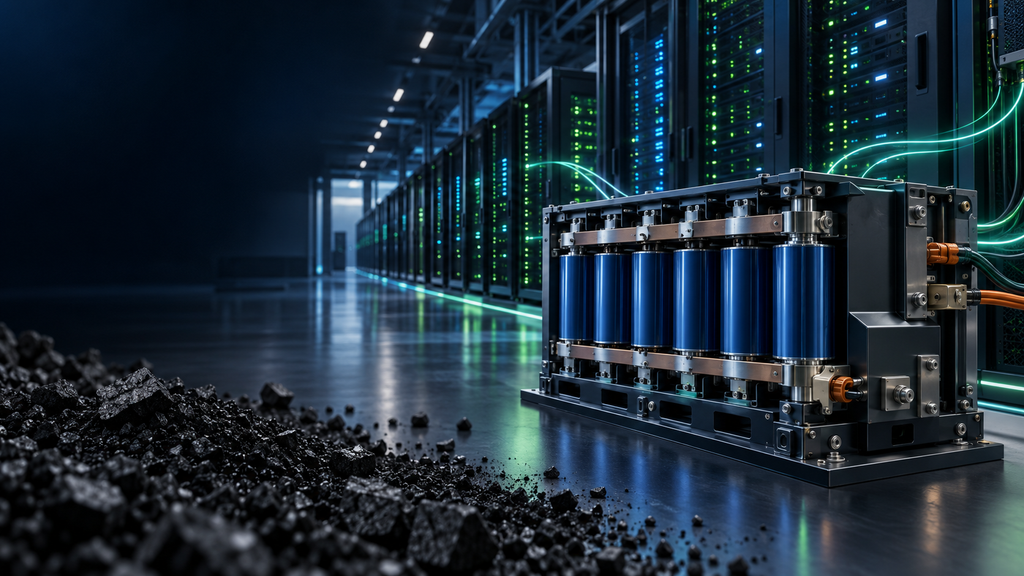
As AI infrastructure expands, the demand for fast, reliable power support will continue to grow. Meeting that demand depends not only on system design, but also on the materials that enable consistent performance within the storage device.
With the HCE 200 series, Haycarb combines specialised electrode-carbon expertise, dependable commercial supply, renewable feedstock, and a measured environmental footprint to support the evolving requirements of high-power energy storage applications.
To learn more about Haycarb’s HCE 200 series and its role in high-power supercapacitor applications, contact our Energy Storage Carbon team.